Free 5th grade worksheets

Estimate and order fractions worksheets

2 printable PDFs, each with its answer key. Estimating sums and differences of fractions and mixed numbers by rounding to 0, 1/2, 1 or a whole number.
  • 2 free PDFs
  • 6 questions each
  • Answer keys
  • US Letter
  • No sign-up
Step 3 of 11 in 5th grade fractions
Estimate and order fractions: free 5th grade math worksheet, sheet 1
+ answer key

Both free sheets

What's on the sheet

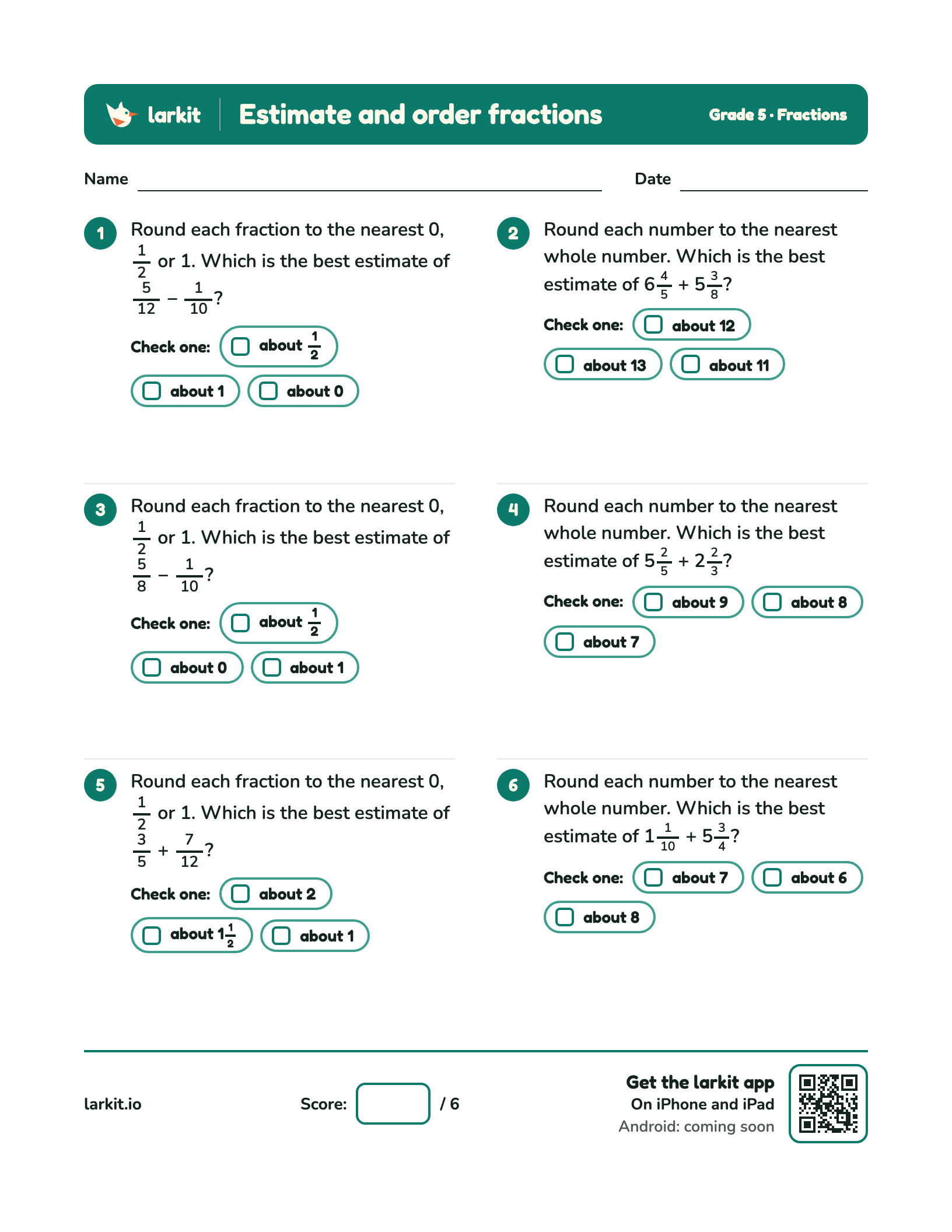
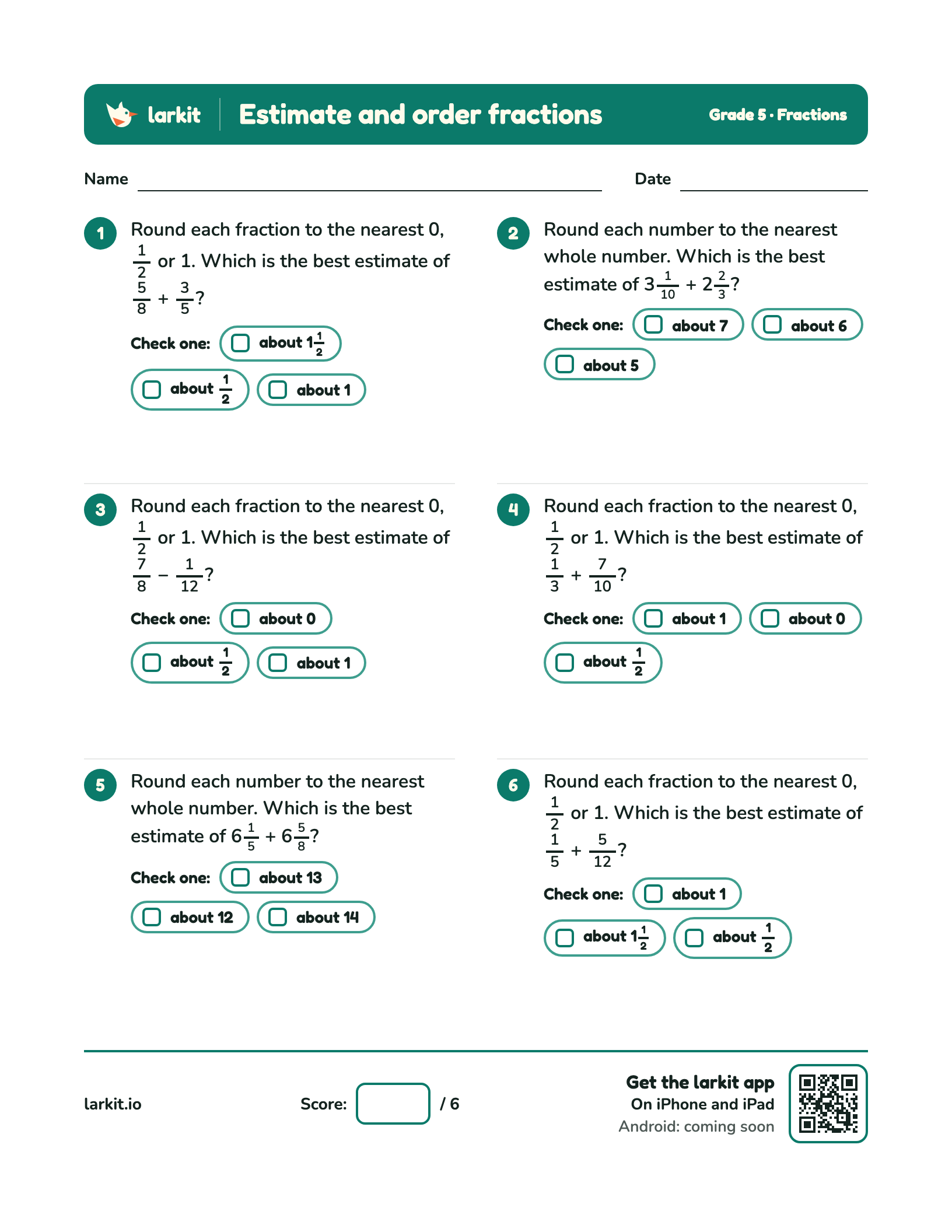
6 questions on US Letter paper, with a box for the score. Some from sheet 1:

  1. Round each fraction to the nearest 0, 1/2 or 1. Which is the best estimate of 5/12 − 1/10?Answer: about 1/2
  2. Round each number to the nearest whole number. Which is the best estimate of 6 4/5 + 5 3/8?Answer: about 12
  3. Round each fraction to the nearest 0, 1/2 or 1. Which is the best estimate of 5/8 − 1/10?Answer: about 1/2
  4. Round each number to the nearest whole number. Which is the best estimate of 5 2/5 + 2 2/3?Answer: about 8

Helping at home

6 4/5 + 5 3/8 is about 12. Fifth graders use benchmark numbers to estimate answers with fractions, rounding each fraction to the nearest 0, 1/2 or 1, or each mixed number to the nearest whole number. These sheets ask for the best estimate of sums and differences.

Rounding by the top or bottom number alone sends 5/12 to 1, because 5 seems big. Comparing the top number to half the bottom number is the quick test: 5/12 is a little less than 6/12, so it is about 1/2.

Ask your child to place a fraction on a line from 0 to 1 before rounding it. For mixed numbers, ask whether the fraction part is more or less than a half. Estimating first is also a good habit for checking any exact answer.

5th grade fractions, step by step

All fractions sheets →
  1. Step 1 · earlierAdd and subtract unlike fractions
  2. Step 2 · before thisAdd and subtract mixed numbers
  3. Step 3 · you're hereEstimate and order fractions
  4. Step 4 · nextFractions as division
  5. Step 5 · laterMultiply fractions
  6. Step 6 · laterArea with fraction sides
  7. Step 7 · laterBigger or smaller products
  8. Step 8 · laterMultiply mixed numbers
  9. Step 9 · laterDivide with unit fractions
  10. Step 10 · laterFractions and decimals
  11. Step 11 · laterLeast common denominators