Sheet 1
4 questions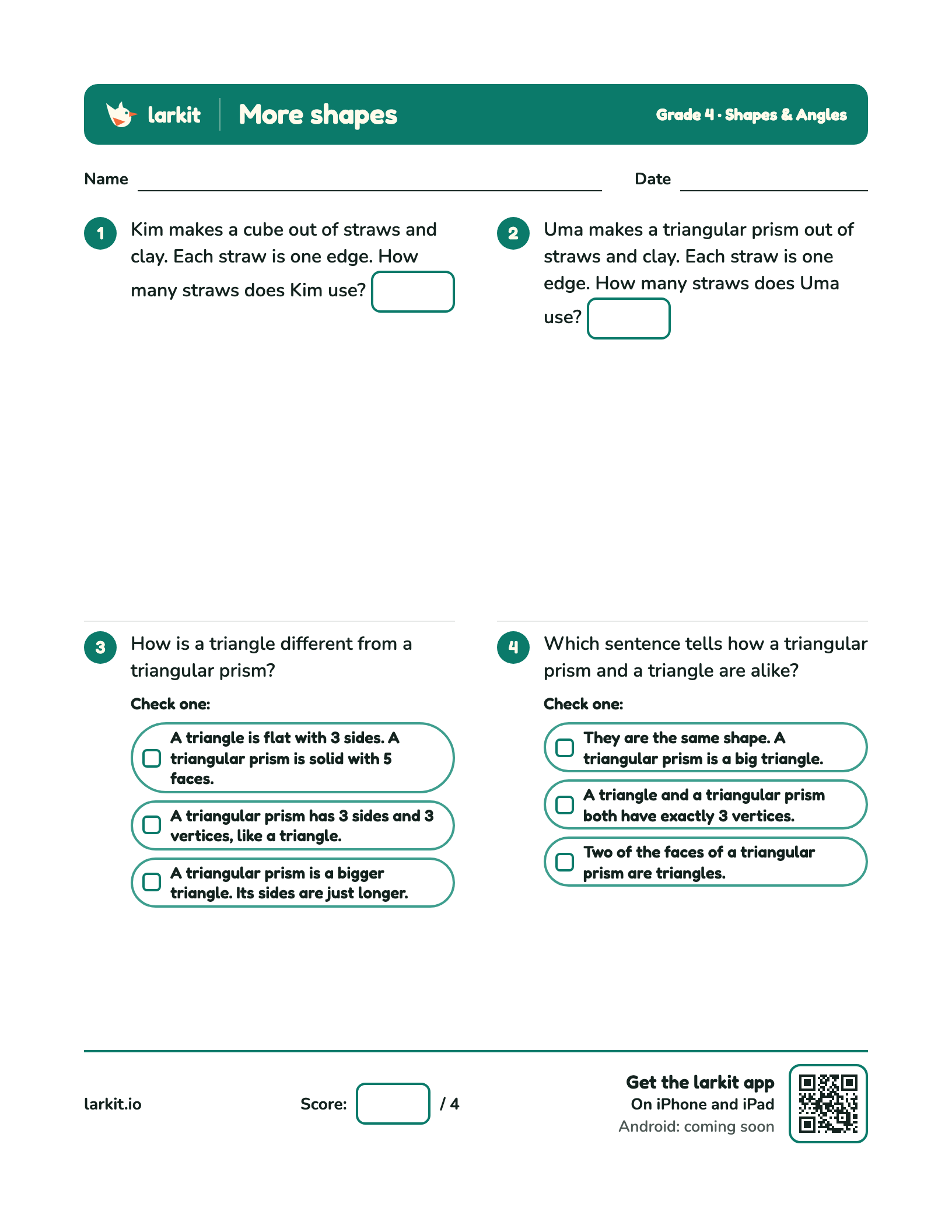
Free 4th grade worksheets
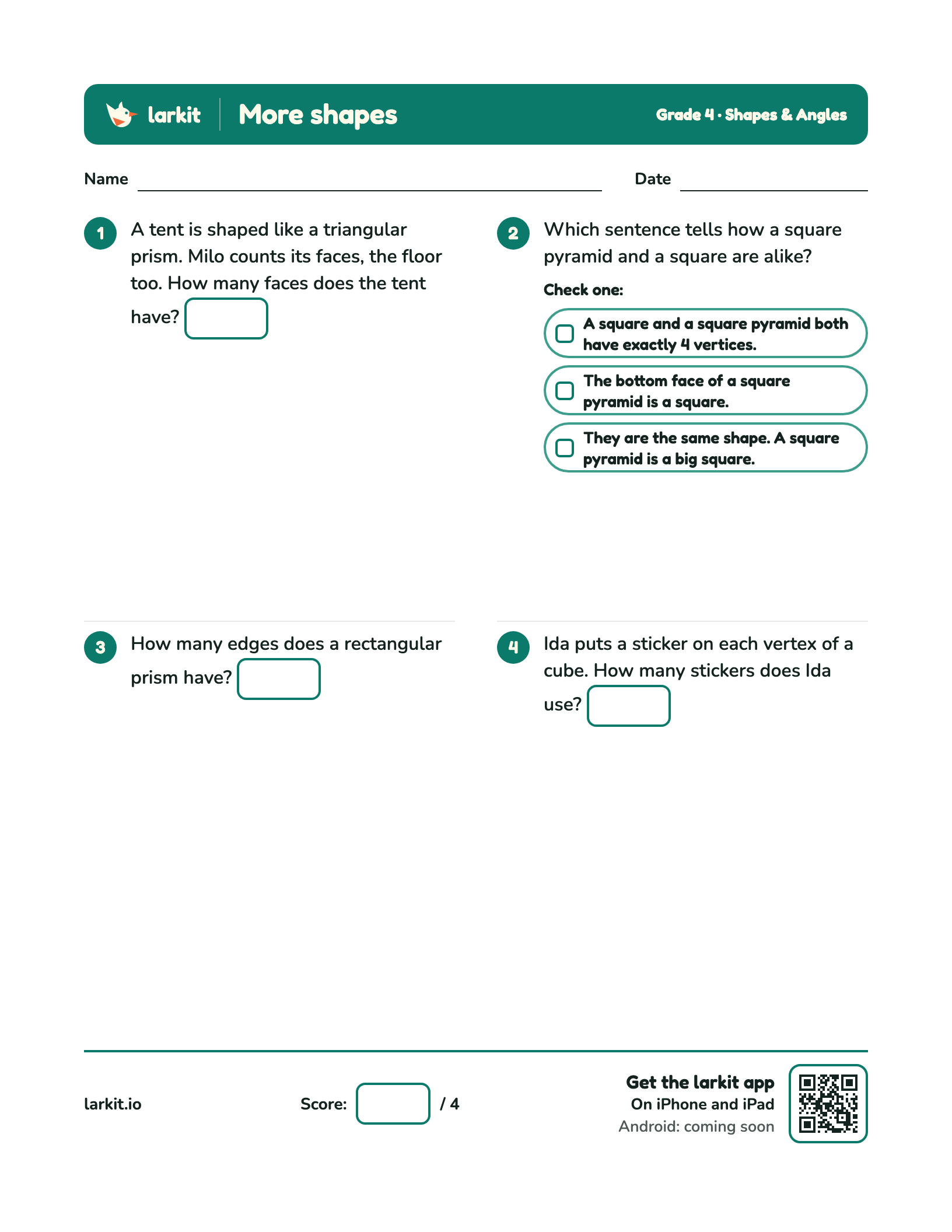
2 printable PDFs, each with its answer key. Faces, edges and vertices of cubes, prisms and pyramids, and how a solid compares to the flat shape on its face.
Worksheet maker
With larkit Premium you make new sheets for any skill, as many as you like, each with its answer key.
4 questions on US Letter paper, with a box for the score. Some from sheet 1:
A cube has 6 faces, 12 edges and 8 vertices. These sheets count those parts on cubes, rectangular prisms, triangular prisms and square pyramids, often through a story like building a cube from straws and clay, where each straw is one edge. Others ask how a solid and a flat shape are alike or different: the bottom face of a square pyramid is a square, but the pyramid is solid.
Edges at the back of a picture are easy to miss, so a child may say a cube has 9 edges. Faces and edges also get swapped. Some kids forget to count the face a solid is sitting on.
Build one. Toothpicks and small balls of clay or mini marshmallows make a cube or a pyramid in a few minutes, and counting is easy when each toothpick is an edge and each ball is a vertex. A cereal box or a tent is a good real rectangular or triangular prism to count faces on together.