Sheet 1
6 questions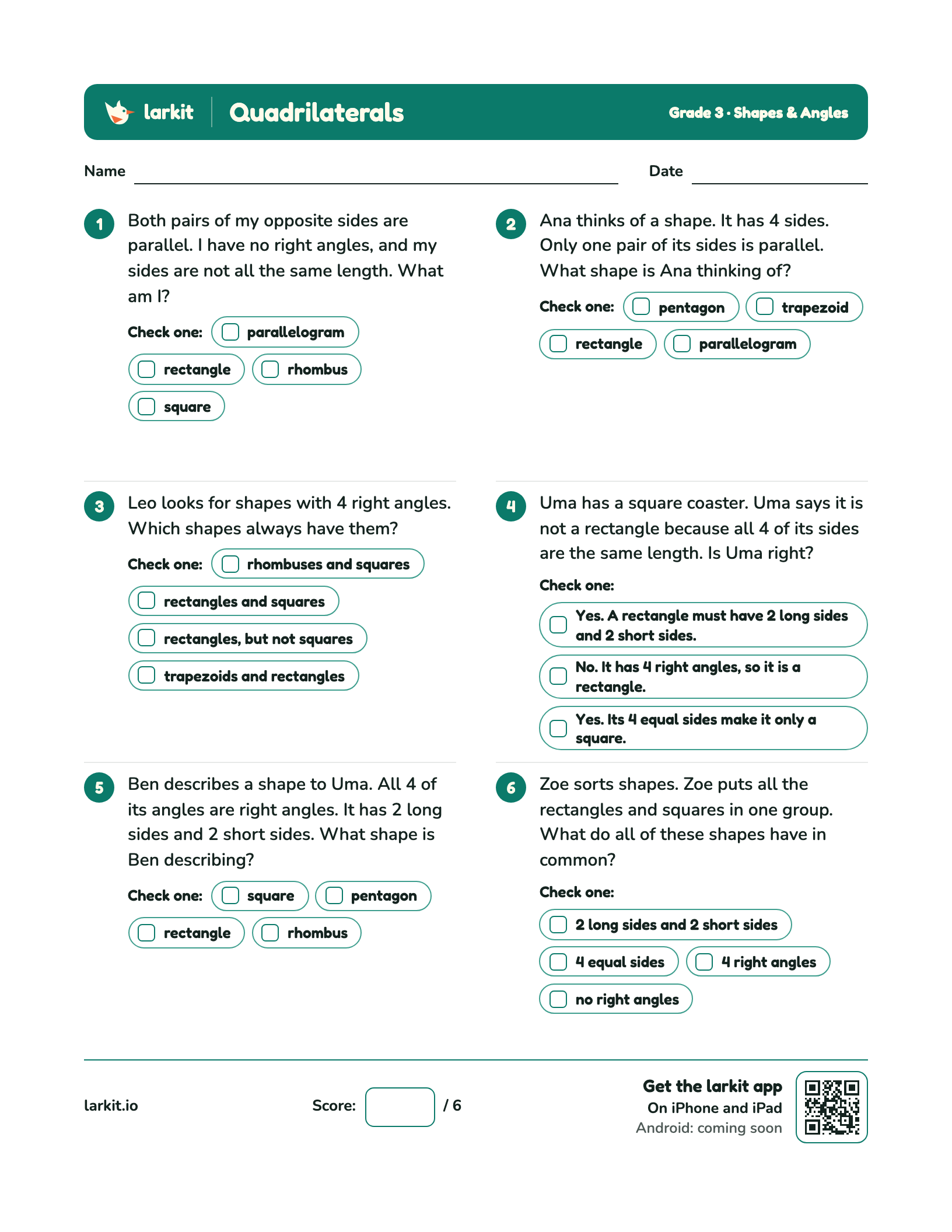
Free 3rd grade worksheets
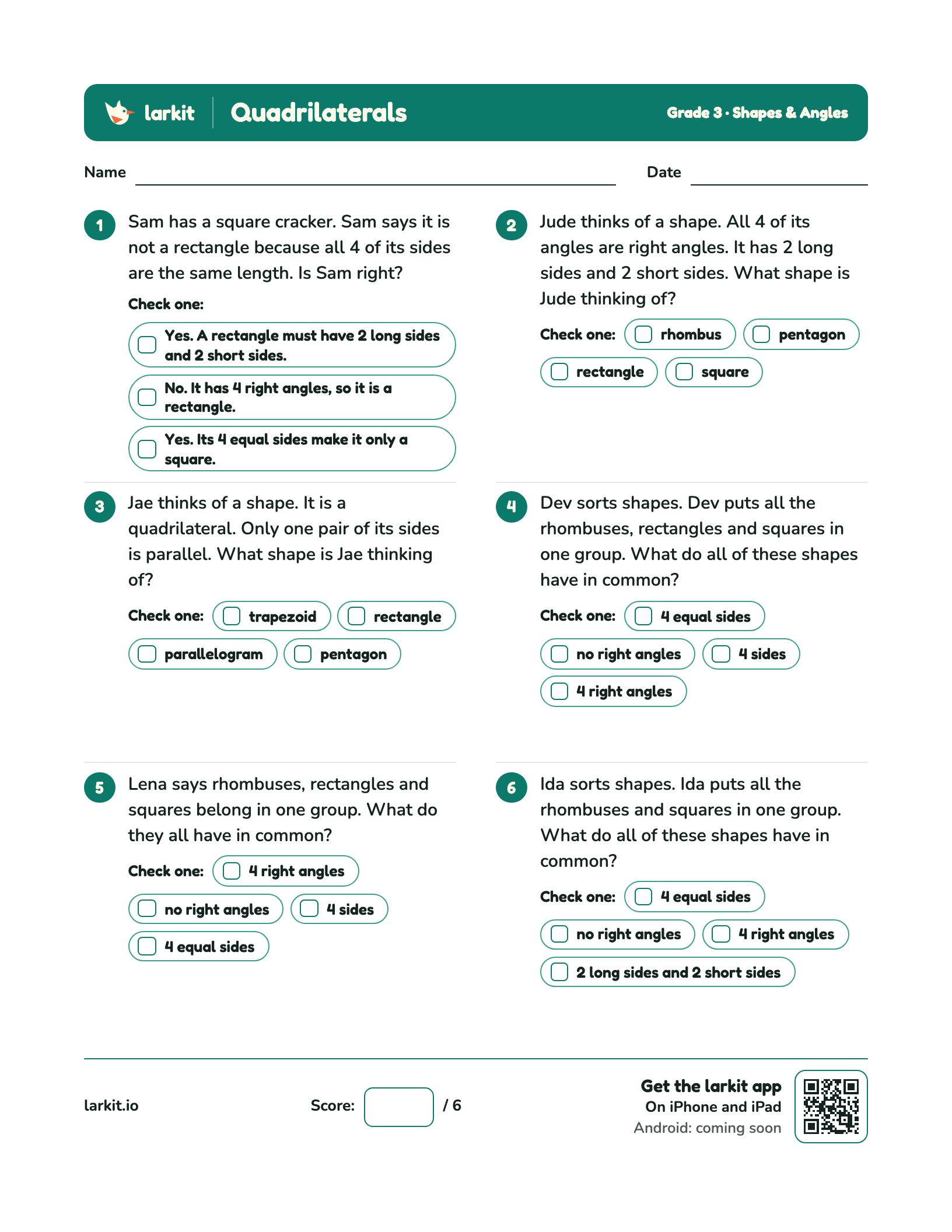
2 printable PDFs, each with its answer key. Rhombuses, rectangles, squares and trapezoids: what makes each one, and what every quadrilateral has in common.
Worksheet maker
With larkit Premium you make new sheets for any skill, as many as you like, each with its answer key.
6 questions on US Letter paper, with a box for the score. Some from sheet 1:
A quadrilateral is any closed shape with 4 straight sides. Third graders sort them into smaller groups by their sides and angles: a rectangle has 4 right angles, a rhombus has 4 equal sides, a square has both, and a trapezoid has only one pair of parallel sides. The sheets give clues and ask for the shape, or ask what a group of shapes shares.
The hard part is that one shape can belong to several groups. A square is also a rectangle and also a rhombus, and children often say it can't be because it "already has a name." Parallel, meaning the sides never meet however far you extend them, is also new.
Draw a few quadrilaterals and play "I'm thinking of a shape" with clues, taking turns. Ask your child to give you clues too. When they describe a square, ask, "Is that also a rectangle?" Arguing it out with the rules in front of you is how the groups start to make sense.