Free 2nd grade worksheets

Part and whole stories worksheets

2 printable PDFs, each with its answer key. Part and whole stories within 100, like blue cars and purple cars together, or pom-poms split between a box and a bin.
  • 2 free PDFs
  • 6 questions each
  • Answer keys
  • US Letter
  • No sign-up
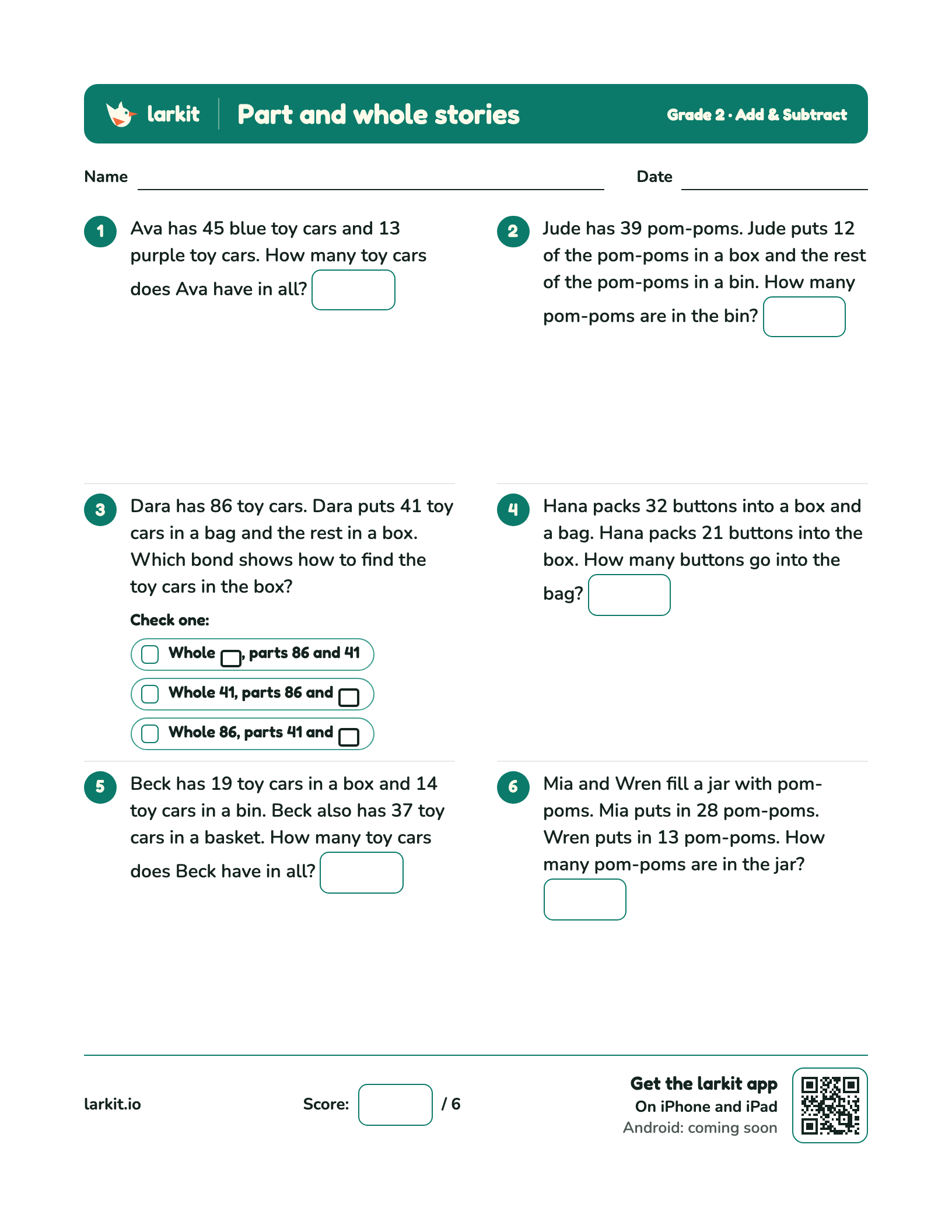
Part and whole stories: free 2nd grade math worksheet, sheet 1
+ answer key

Both free sheets

What's on the sheet

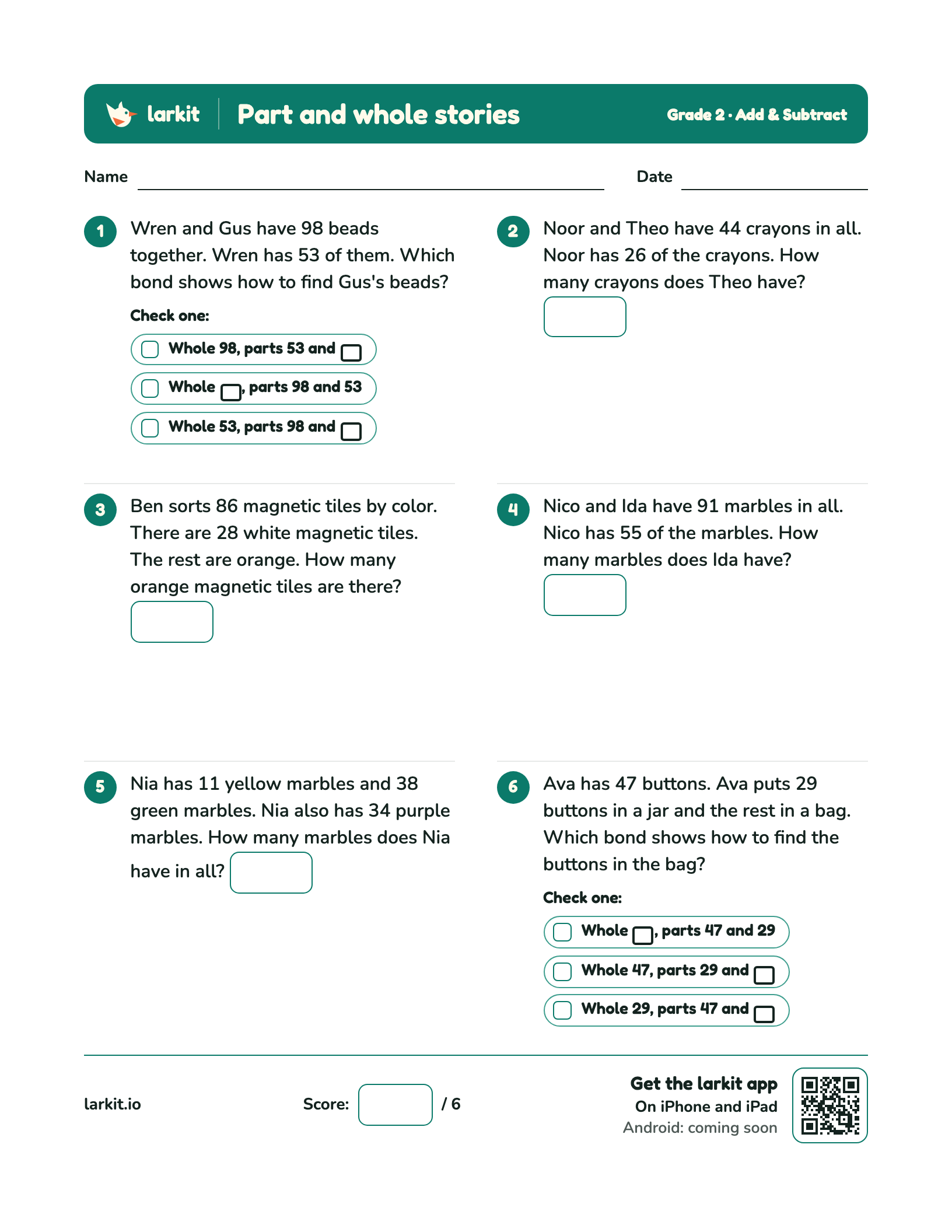
6 questions on US Letter paper, with a box for the score. Some from sheet 1:

  1. Ava has 45 blue toy cars and 13 purple toy cars. How many toy cars does Ava have in all?Answer: 58
  2. Jude has 39 pom-poms. Jude puts 12 of the pom-poms in a box and the rest of the pom-poms in a bin. How many pom-poms are in the bin?Answer: 27
  3. Dara has 86 toy cars. Dara puts 41 toy cars in a bag and the rest in a box. Which bond shows how to find the toy cars in the box?Answer: Whole 86, parts 41 and □
  4. Hana packs 32 buttons into a box and a bag. Hana packs 21 buttons into the box. How many buttons go into the bag?Answer: 11

Helping at home

A part-whole story has two parts and a whole. Ava has 45 blue cars and 13 purple ones, so she has 58 in all. Jude has 39 pom-poms, puts 12 in a box, and the rest in a bin, so 27 go in the bin. Some questions ask which number bond matches the story.

When the whole is given and a part is missing, kids often add the two numbers they see. Reading the story for the word that means everything, like "in all" or "has 39," helps find the whole.

Sketch a number bond with the whole on top and the two parts below. Your child fills in what they know and puts a box where something is missing. That picture tells them whether to add or subtract before any math happens.

2nd grade word problems, step by step

All word problems sheets →
  1. Step 1 · before thisAdd and take away stories
  2. Step 2 · you're herePart and whole stories
  3. Step 3 · nextCompare stories
  4. Step 4 · laterFind the missing number
  5. Step 5 · laterTwo-step stories
  6. Step 6 · laterStories with packs, boxes and rows
  7. Step 7 · laterFraction stories
  8. Step 8 · laterStories with bigger numbers
  9. Step 9 · laterShare into equal groups