Sheet 1
Free 2nd grade worksheets
2 printable PDFs, each with its answer key. Rectangles split into rows and columns of same-size squares: counting the squares, picking the addition sentence that adds the rows, and drawing the lines on a dot grid.
Worksheet maker
With larkit Premium you make new sheets for any skill, as many as you like, each with its answer key.
One page of US Letter paper, with a box for the score, and its answer key on a page of its own.
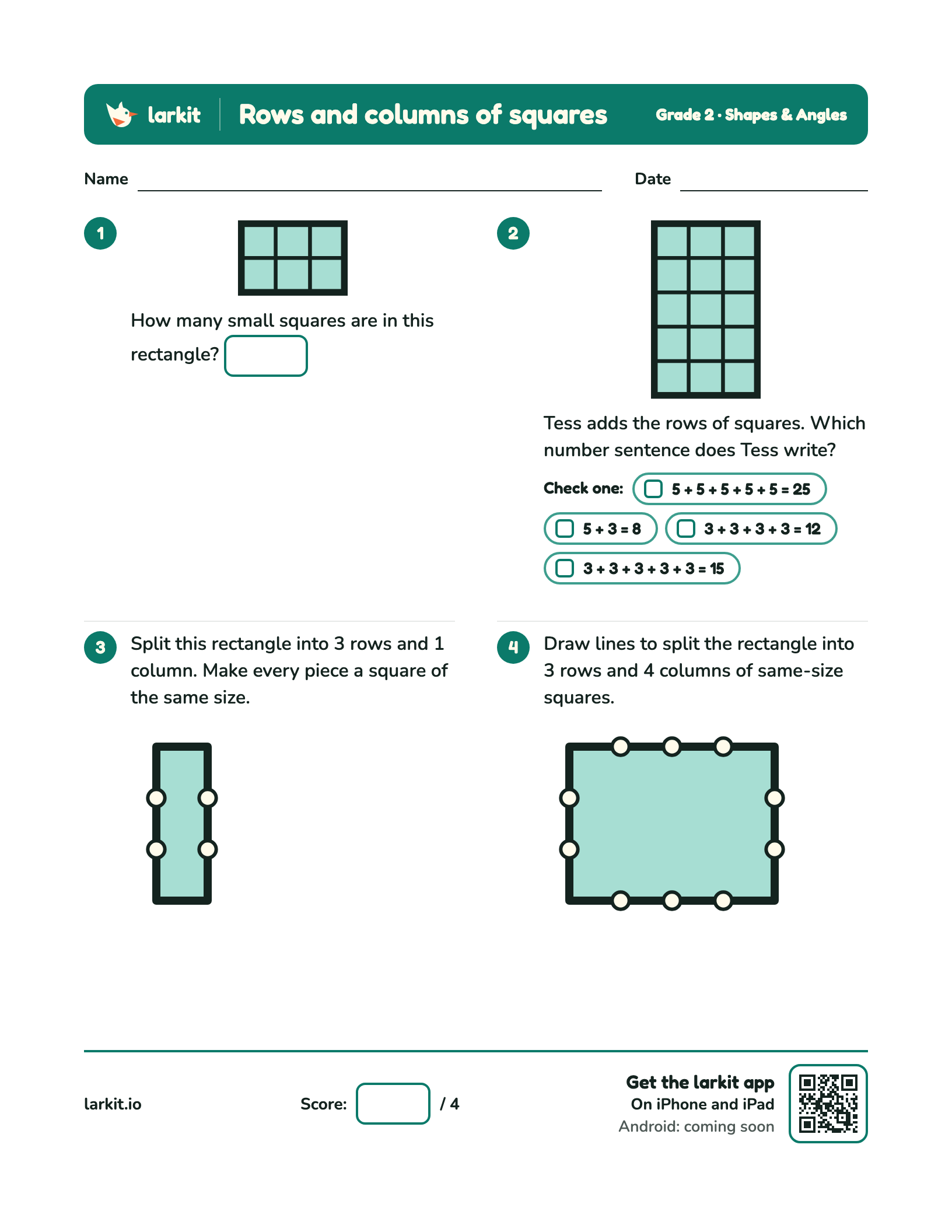
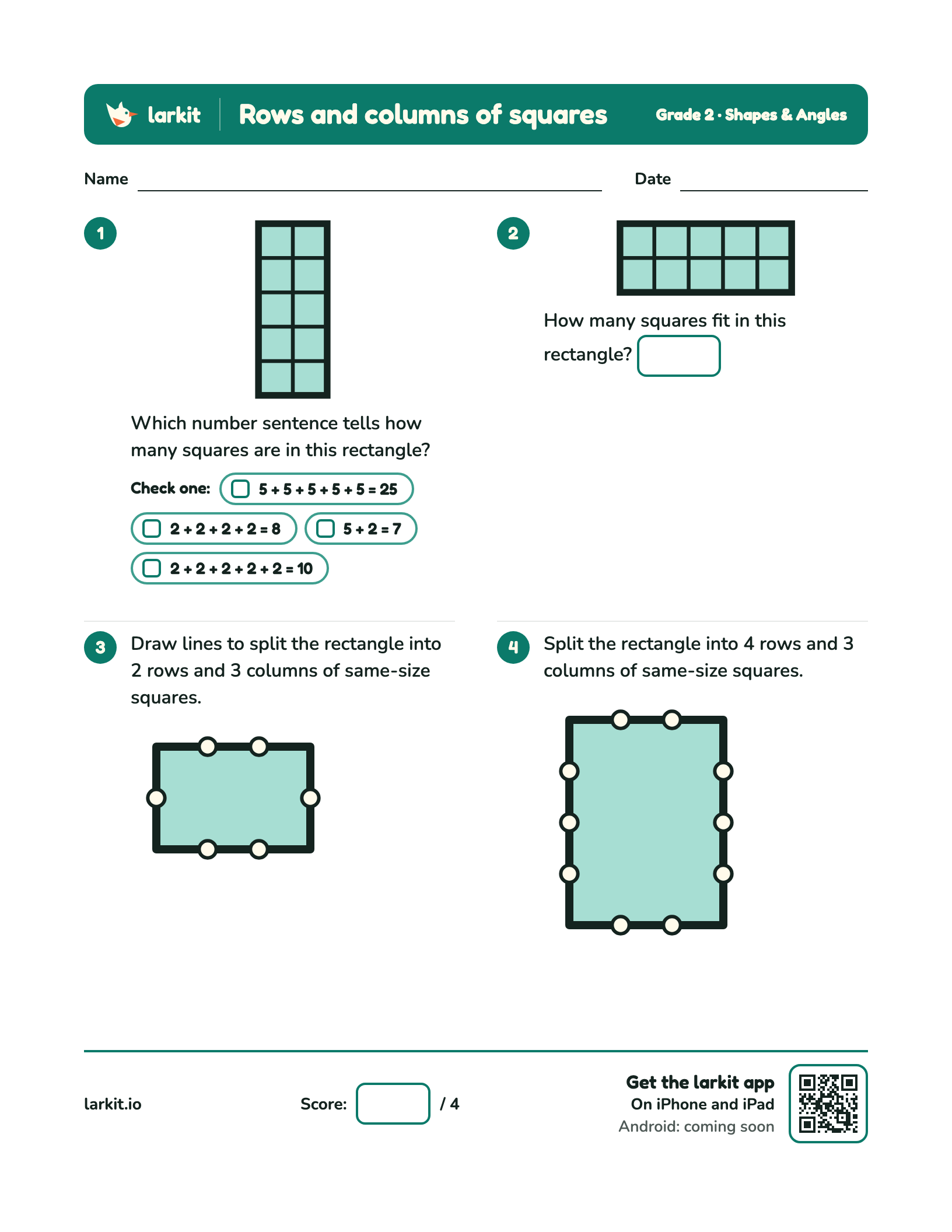
A rectangle can be cut into rows and columns of same-size squares, and second graders find that counting them a row at a time is quicker than one by one. Some questions show a rectangle already split and ask how many squares cover it, or which number sentence adds its rows, like 3 + 3 + 3 + 3 + 3 = 15. In the others, the rectangle is drawn on a grid of dots and your child draws the lines that split it into 2 rows and 3 columns, or 4 rows and 3 columns.
Rows go across and columns go up and down, and the two get mixed up all the time, so 2 rows of 3 comes out as 3 rows of 2. Drawn squares often end up uneven, with one row taller than the rest. Joining the dots in straight lines keeps every square the same size. When counting, some children count the squares on the edges twice.
A muffin tin, an egg carton or a bar of chocolate with squares is a ready-made rectangle of rows and columns. Count the rows, count how many are in each one, then add the rows together: 4 + 4 + 4 = 12. On squared paper, draw a rectangle and let your child split it for you to count.